Think about it.
A free, live, personality-driven audio platform
With mass daily reach
Hyper-local targeting
Built-in community credibility
No login required
No subscription barrier
No algorithm deciding who sees it
And the ability to move thousands of people at the same moment.
If that launched in 2026, it would be branded as:
“The world’s first real-time, location-based audio influence network.”
There would be seed funding.
There would be a valuation conversation.
Instead, because it’s 100 years old, we call it “traditional.”
The irony?
Every new audio platform is trying to replicate one of radio’s original superpowers:
Habit.
Trust.
Scale.
Shared experience.
Innovation isn’t always about inventing something new.
Sometimes it’s about recognizing the power of what’s already here.
If you found this insight useful, I post regularly about how audio shapes demand and delivers ROI — hit follow to stay in the loop.
Get THE TRUTH ABOUT RADIO on Amazon.
Listen to The Truth About Radio podcast (or find it on Apple Podcasts, Spotify, or wherever you get your podcasts)
This post is original content. Please share with credit. © 2026 Dave Sturgeon
hashtag#BroadcastLeadership hashtag#RadioSales hashtag#MediaStrategy hashtag#AudioAdvertising hashtag#StationManagement hashtag#LocalMedia hashtag#AdvertisingROI hashtag#MediaBuying hashtag#RadioIndustry
RTVA Blog Archives for 2026-02
World Radio Day
RADIO
The only medium declared “dead” every five years…
…for the last 100 years.
Here’s the inconvenient truth:
Radio has outlived:
• Television panic
• The iPod revolution
• Streaming hype
• Podcast obsession
• Social media dominance
• Algorithm addiction
And it’s still the #1 audio platform in the world.
Not surviving.
Leading.
Every day, millions of people wake up and voluntarily invite radio into their morning. No login. No subscription. No scrolling. No password reset.
Just presence.
While digital fights for attention, radio already owns it.
While social chases impressions, radio builds relationships.
While platforms tweak algorithms, radio builds memory.
Here’s what makes radio dangerous (in the best way):
It doesn’t just distribute ads.
It transfers trust.
A trusted voice endorsing a brand isn’t an impression.
It’s a handshake at scale.
It’s credibility borrowed and belief accelerated.
You can’t shake 50,000 hands before 9 a.m.
But a morning show can.
That’s not nostalgia.
That’s influence.
On World Radio Day, don’t celebrate radio because it’s old.
Celebrate it because it’s the gravitational force of the audio universe.
And the platforms fighting for attention?
They’re still trying to replicate what radio has done naturally for a century.
Digital captures demand.
Radio creates it.
And always will.
Get THE TRUTH ABOUT RADIO on Amazon
Listen to The Truth About Radio podcast
(or find it on Apple Podcasts, Spotify, or wherever you get your podcasts)
This post is original content. Please share with credit. © 2025 Dave Sturgeon
#WorldRadioDay #RadioSales #BroadcastLeadership #AudioAdvertising #TheTruthAboutRadio #RadioWorks #MediaStrategy
Shake Hands with 50,000 Customers Before 9am
Your Brand Isn’t Fully Trusted Until It’s Heard
You can invest in:
- Signs
- A beautiful website
- Wrapped vehicles
- Matching uniforms
All good. All necessary.
But here’s the part most marketers miss…
We don’t truly believe something until we hear it from a voice we trust.
That’s why local radio endorsements work differently from all other ad types.
A strong on-air personality doesn’t just introduce your brand — they vouch for it.
Word of Mouth advertising on steroids!
And that’s when trust scales.
You can’t shake 50,000 hands.
But our morning show did it for you before 9am.
That’s not just radio reach.
That’s radio belief.
Myth: Radio sells airtime
Truth: Radio sells credibility
If you're planning your 2026 marketing budget, make sure it includes something that can speak for you.
Literally.
—
Get THE TRUTH ABOUT RADIO on Amazon
???? Listen to The Truth About Radio podcast here
(or find it on Apple Podcasts, Spotify, or wherever you get podcasts)
This post is original content. Please share with credit. © 2025 Dave Sturgeon
hashtag#RadioIsOG hashtag#MythVsTruth hashtag#NiagaraBusiness hashtag#TrustEconomy hashtag#AudioInfluence hashtag#MarketingStrategy
Reframing Scarcity as Strength
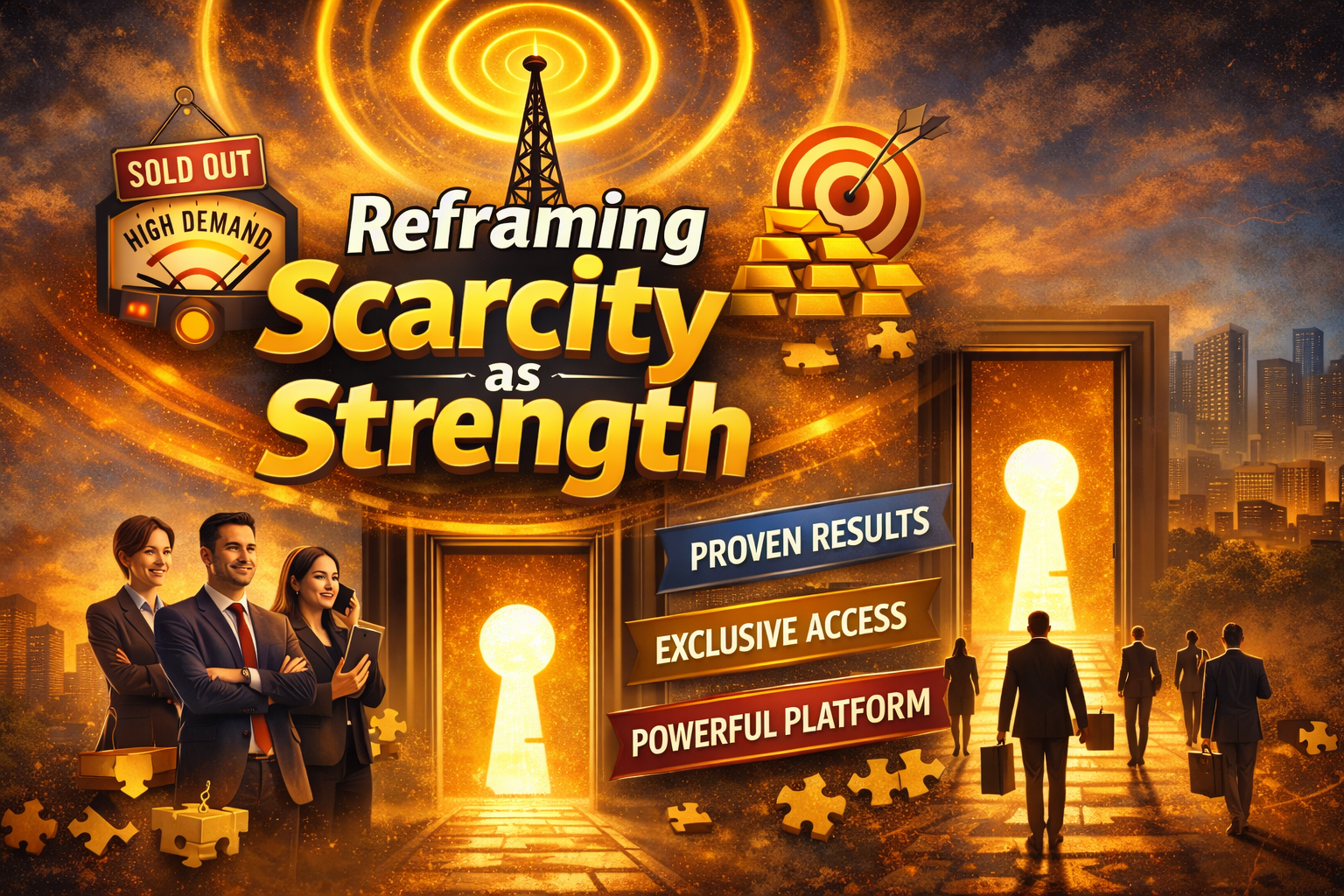
When you truly understand your value, scarcity stops being something you apologize for—and starts becoming your strongest story.
Too many radio stations still treat sold-out inventory like a problem to be solved. It isn’t. It’s proof of demand. It’s evidence that the product works. Scarcity doesn’t signal weakness; it signals success.
Scarcity says, “This platform delivers results.”
It says, “Advertisers want access to this audience.”
And it says, “If you want in, you need to act—because others already understand the power here.”
The moment a seller internalizes that truth, everything changes.
They stop sounding like vendors scrambling to fill space and start speaking like advocates for a platform they believe in. Their posture shifts. Their confidence sharpens. Their conversations feel less transactional and far more intentional.
Radio doesn’t need to be defended. It needs to be championed.
This is a medium that can still drive mass awareness overnight—while also being measurable, targetable, and more trusted than any algorithmically curated feed. That combination isn’t a liability. It’s an unfair advantage. But only if sellers believe it.
When sales teams become believers, they stop chasing clients and start curating partnerships. They stop negotiating against themselves. They stop leading with price and start leading with outcomes.
That’s the real mindset shift:
-
From filling spots to offering access
-
From discounting rates to defending results
-
From selling time to selling transformation
Scarcity is strength. Belief is contagious.
And when an entire team sees themselves as evangelists for radio—rather than order-takers for airtime—you don’t just fill logs.
You fill pipelines.
You fill calendars.
You fill the market with confidence.
That’s what happens when you lead with belief.
Most Advertising Conversations Start with the Wrong Question
“How many impressions will I get?”
That’s a passive media-buy mindset.
Radio operates at a different level.
When a business shows up consistently on a local radio station, it doesn’t just get heard — it starts taking over mental real estate in that market. Over time, the brand stops sounding like one of the options and starts sounding like the obvious choice. Familiarity compounds. Repetition reinforces credibility. Presence turns into preference.
That’s because radio doesn’t chase people around the internet.
It meets them where they already are — in the car, in routines, in real life — day after day, week after week. It becomes part of the soundtrack of someone’s normal day, not an interruption they’re trying to skip, mute, or scroll past.
Digital ads appear… then disappear.
Radio stays.
And that consistency does something powerful:
• It builds familiarity before urgency
• Trust before need
• Preference before price
By the time a consumer opens Google, checks reviews, or clicks an ad, the decision has often already been made. Digital captures demand — radio creates it. One responds to intent; the other shapes it long before the moment of action.
That’s why the strongest radio advertisers don’t obsess over clicks, CPMs, or dashboards. They notice something far more valuable:
“Everyone already knows us.”
That’s not luck.
That’s not nostalgia.
That’s positioning.
Radio isn’t something you buy.
It’s something you occupy.