
For years, newsletters have been treated like the sensible shoes of digital strategy. Practical, reliable, not exactly sexy. Meanwhile, stations chased podcasts, short-form video, social platforms, and whatever shiny new object was trending that week.
Then along came the receipts.
In a recent post, Fred Jacobs laid it out clearly, backed by fresh Techsurvey 2026 data.
Newsletters are not just relevant, they are dominating daily usage among core radio fans. And not by a little.
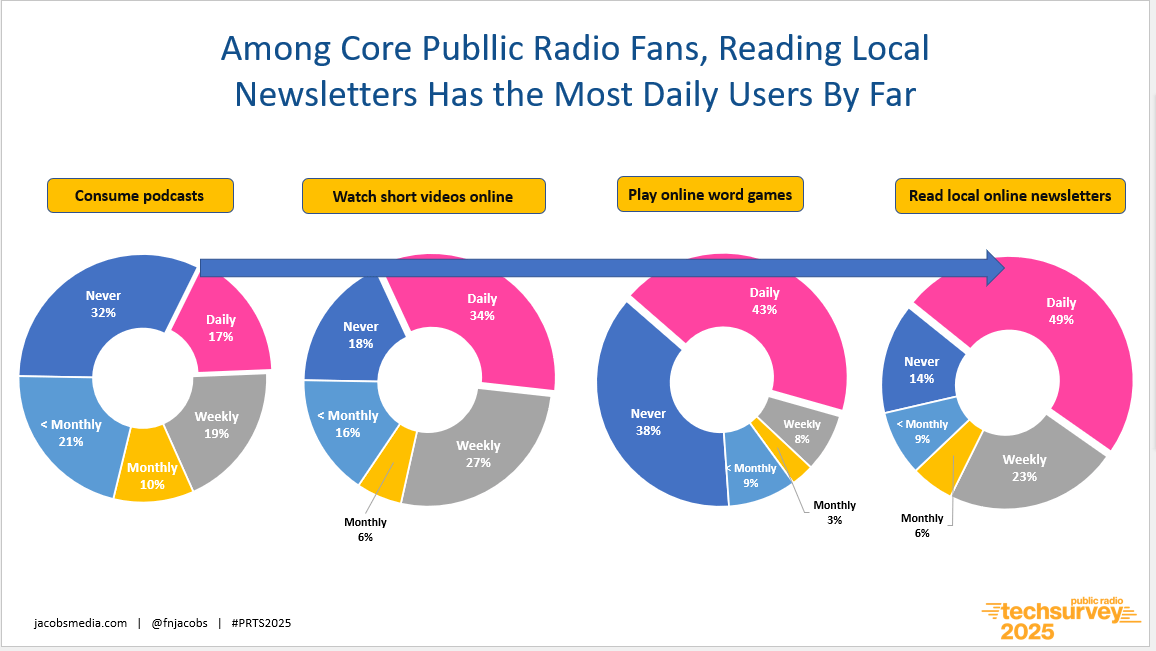
Among the most loyal users, reading local online newsletters beats podcasts, short videos, and online games for daily engagement, by a wide margin. Nearly half of core users read newsletters daily, compared to just 17 percent for podcasts. That pink slice in Fred’s chart says everything programmers and managers need to know.
This is not about trends. This is about habits.
As Fred puts it,
“Online newsletters have become a habit for millions of us.”
That distinction matters, because habits are where monetization lives. Habits are where loyalty lives. Habits are where brands stop renting attention and start owning it.
And owning the audience is the whole game now.
The Wall Street Journal recently called this moment “The Year the Newsletter Business Reached a Fever Pitch,” noting explosive growth on platforms like Substack, which now boasts 5 million paid subscriptions, up nearly 67 percent year over year.
As Alexandra Bruell reported,
“If 2024 was the year of the podcast, 2025 was the year of the newsletter.”
The radio industry has heard that message, but many stations still hesitate. Newsletters feel mundane. They do not come with viral bragging rights. No one ever says, “Hey Fred, check out our station newsletter,” which he admits is telling.
But boring is not the same as ineffective. In fact, boring might be the point.
Newsletters sit in a rare sweet spot. They are owned and operated, meaning stations control the relationship, the data, and the distribution. No algorithm mood swings. No platform rug-pulls. Just a direct line to the audience, delivered daily, weekly, or however often you earn the right to show up.
That first-party data is gold.
For decades, radio outsourced its most valuable asset, listener information, to ratings companies, social platforms, and podcast distributors. Newsletters flip that script. As Tyler Denk, founder and CEO of Beehiiv, put it bluntly,
“There is a stronger push on owning your audience and distribution.”
That quote should be taped to every GM’s monitor.
Now here’s where most stations hit the wall. They understand the opportunity, but not the execution. Newsletters require consistency, relevance, local intelligence, and sales integration. That is where good intentions usually go to die, buried under staffing shortages and already-overloaded content teams.
Enter LocalBeat
This is exactly the gap LocalBeat was built to fill.
LocalBeat turns newsletters into infrastructure, not a side project. The local content engine not only updates with fresh content 24/7, it automatically generates targeted, local email newsletters, personalized by topic, populated with timely community content, and delivered without daily human intervention. No frantic 5 a.m. scrambles. No missed sends. No burnout.
Just as important, LocalBeat was designed with monetization baked in, not bolted on. Sponsor placements, local advertisers, and scalable sales opportunities are part of the system from day one.
When newsletters are the most-used daily digital habit among your core fans, selling against that attention stops being hard.
This is not about replacing podcasts, video, or social. It is about prioritizing the platform that already wins on daily usage, data ownership, and revenue reliability.
Newsletters are not a silver bullet. Mediocre newsletters will fail just as fast as mediocre podcasts. But smart, local, consistent newsletters, powered by automation and focused on ownership, are quietly becoming radio’s most dependable growth engine.
The humble newsletter is no longer humble.
It is strategic. It is habitual. it may be radio’s best digital move this decade.
Find out how LocalBeat makes it fast, easy, and automatic. Go here to get details and chat with me about how it can work for you and your company.
Ava Hart is the digital spokesperson for Radio Content Pro — the radio industry’s most innovative content provider — and its unapologetic voice for creativity, connection, and a little controlled chaos. Known as radio’s revolutionist with sass, she blends sharp wit, tech-savvy smarts, and a love for authentic storytelling to help broadcasters thriving in a fast-changing media world.
?